
How to Evaluate a Yacht Listing: What “Verified” Actually Means
Learn how listings end up inaccurate or fake, and what signals to watch for.


When you search for yachts online, the results look similar regardless of which platform you use. A photo, a price, a length, a location, a broker's name. The listing appears real. The boat appears available. The specifications appear accurate.
Often, none of those assumptions hold.
Yacht listing quality varies more dramatically than most buyers realise: not just between platforms, but within the same platform on the same day. Understanding what "verified" actually means, how listings end up inaccurate or fake, and what signals to look for before you invest time in any specific vessel is one of the most practical things a buyer can learn before starting a search.
The Problem With Most Yacht Listings
The yacht brokerage market is built on trust, but the platforms that aggregate listings are not always built on verification. Most major listing platforms operate as open databases: any subscribing broker can submit a listing, and the platform publishes it with minimal independent checks on accuracy, availability, or authenticity.
The result is a market with four persistent problems that affect buyers every day.
1. Ghost listings
A ghost listing is a vessel listed for sale that either does not exist, has already been sold, or is being listed without the owner's genuine authorisation. The purpose is typically to attract buyer enquiries, at which point the broker who created the ghost listing attempts to redirect the buyer toward a real vessel they do represent: positioning themselves as the buyer's representative and earning a commission they would not otherwise have access to.
Ghost listings tend to be priced below comparable vessels on the same platform, which is what makes them effective. A buyer searching by price finds the ghost listing first, contacts the broker, and is told the vessel has "just sold" or is "no longer available"... followed immediately by an offer to help find something similar.
2. Duplicate listings
A single vessel can appear multiple times on the same platform: sometimes submitted by the same brokerage under different formats, sometimes submitted by multiple brokers competing for buyer enquiries on the same boat. This happens most commonly when a vessel is listed under an open listing agreement, where the owner gives multiple brokers the right to market the yacht simultaneously rather than appointing a single central agent.
Duplicate listings distort the buyer's sense of market conditions. A buyer who sees the same 60-foot motor yacht listed by four different brokers at slightly different prices may believe there are four separate vessels available, or may conclude that the pricing discrepancy signals a problem with the boat. Neither conclusion is accurate, but both waste the buyer's time and erode trust in the search process.
3. Expired listings for sold vessels
Many platforms do not systematically remove listings when a vessel sells. Sold boats can remain visible in search results for weeks or months after a transaction closes — particularly if the listing broker is no longer active or the platform relies on brokers to self-report sold status. A buyer who identifies a vessel, researches it thoroughly, contacts the broker, and is then told it sold months ago has invested time that a better-curated platform would have protected.
4. Inaccurate specifications
Even genuine listings for genuinely available vessels frequently contain inaccurate data — wrong engine hours, outdated pricing, specifications transcribed from memory rather than manufacturer documentation, or photos taken years ago that no longer reflect the vessel's actual condition. Because most platforms allow brokers to self-enter all data without any independent verification against manufacturer records, the accuracy of a listing depends entirely on the care and honesty of the individual who created it.
What "Verified" Means... and What It Doesn't
The word "verified" is used in several different ways across the industry, and not all of them are equally meaningful for a buyer.
Verified broker credentials
Some platforms verify that the broker submitting a listing holds a valid brokerage licence and is a member in good standing of a recognised industry association. This is a meaningful form of verification: it establishes that the person listing the vessel is a credentialed professional operating under a code of ethics, with dispute resolution mechanisms available if something goes wrong.
The two most important US broker credentialing programmes are:
- CPYB — Certified Professional Yacht Broker, jointly administered by the Yacht Brokers Association of America (YBAA) and partner associations including IYBA, CYBA, and NYBA. CPYB brokers have passed a three-hour examination, maintain a dedicated client escrow account, and commit to an ongoing code of ethics and continuing education requirements.
- IYBA — International Yacht Brokers Association, the world's largest yacht broker association with over 2,000 members, which requires member brokers to adhere to professional standards and provides formal dispute resolution for transactions gone wrong.
Platforms that require one of these credentials as a condition of listing provide a meaningful professional floor. Yachtr, for example, requires IYBA membership; YATCO accepts only professional members operating under an association-backed code of conduct.
Being a credentialed broker does not guarantee that every specification in every listing is accurate: but it does mean the broker has agreed to professional standards and can be held accountable through their association if they violate them.
Verified listing agreements
A separate question is whether the listing is backed by a valid signed agreement between the broker and the vessel's owner. In the professional brokerage market, the gold standard is a Central Agency Agreement: an exclusive arrangement in which one broker is appointed by the owner to manage the sale, with all enquiries channelled through that central agent. Central listings can be entered into the industry MLS (YachtBroker.org), co-brokered with other professionals, and marketed comprehensively because the listing broker's commission is protected regardless of which broker ultimately brings the buyer.
Open listings, where an owner lists with multiple brokers simultaneouslyl are less reliable from a buyer's perspective. Because no broker has exclusive responsibility for the vessel, accuracy updates, price changes, and sold notifications are applied less consistently. YATCO explicitly requires that all its listings be Central Agency Agreements, which provides a meaningful quality floor on this dimension.
Verified manufacturer specifications
The most rigorous form of listing verification, and the least common, involves cross-referencing a vessel's specifications against the manufacturer's original build data using the hull identification number (HIN) or equivalent shipyard build number. This confirms that the dimensions, engine type, displacement, fuel capacity, and other parameters in the listing match what the shipyard actually delivered, rather than what the broker believes or the previous owner reported.
YachtWay verifies manufacturer specifications directly for authorised dealer listings, so buyers researching a specific make and model can rely on the published specifications being sourced from the manufacturer. This level of verification is not available on most other major platforms, where data accuracy depends entirely on what the listing broker entered.
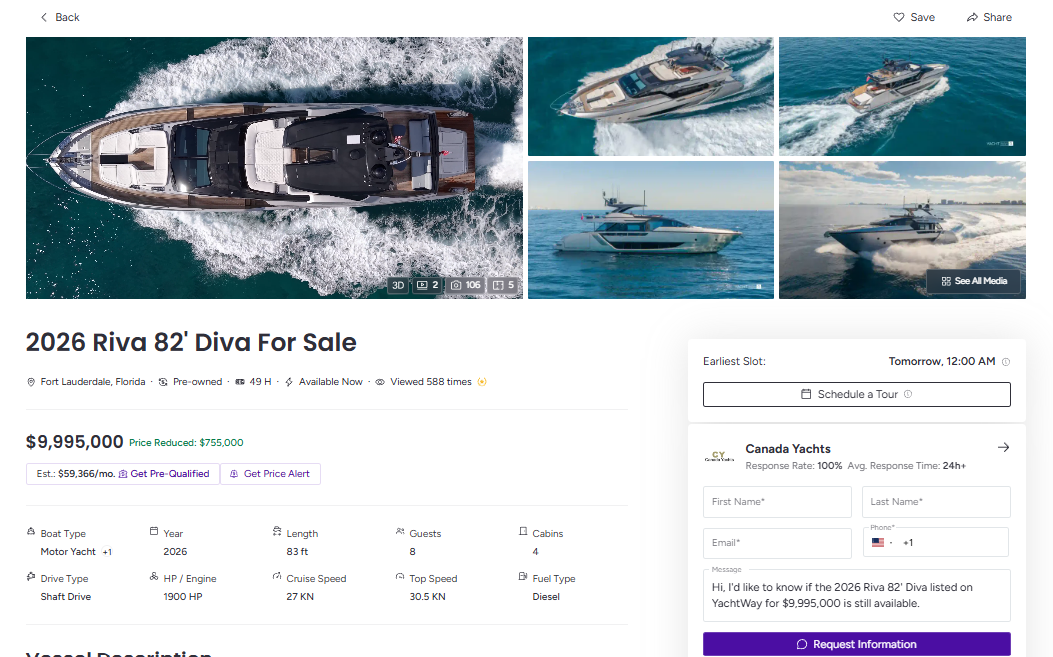
What to Look For in Any Listing
Regardless of which platform you are using, these are the practical signals that distinguish a reliable listing from one that warrants caution.
A named central agent. The listing should identify a specific broker or brokerage as the exclusive listing agent. If a vessel appears on multiple platforms under multiple broker names with no consistency, it is either an open listing or a ghost listing: proceed carefully either way.
Consistent pricing across platforms. If the same vessel appears at meaningfully different prices on different sites, the discrepancy is worth investigating. Sometimes one price reflects a recent reduction that hasn't been updated everywhere; sometimes the difference is more concerning.
Current, dated photography. Photos that appear seasonal (summer sun on a vessel now listed in a northern winter market) or that show dated features inconsistent with the listing year are worth questioning before investing further time.
Manufacturer-consistent specifications. If you know the model well enough to have expectations about its standard specifications, compare what the listing states against published manufacturer data. Discrepancies in engine configuration, displacement, or dimensions are worth flagging with the broker.
A verifiable Hull Identification Number. Any legitimate listing for a used vessel should be able to provide the HIN upon request. With the HIN, a buyer can run a title search through the US Coast Guard's National Vessel Documentation Center (NVDC): the official federal database for documented US vessels. This search reveals the vessel's documented name, official number, flag, dimensions, and certificate of documentation status. For full ownership history and any recorded liens or encumbrances, an Abstract of Title can be requested directly from the NVDC.
Responsive, specific broker communication. A broker who answers questions about the vessel's history, condition, maintenance records, and survey history with specificity and confidence is almost always representing a genuine listing. A broker who deflects or pivots quickly to alternative vessels is a signal worth taking seriously.
How Platform Choice Affects Listing Quality
The platform you search on determines the baseline quality every listing must meet before appearing in your results; not a ceiling, but a floor.
Platforms that accept open broker subscriptions with minimal vetting will contain ghost listings, duplicates, expired listings, and inaccurate data as a structural feature of their model. This does not make them useless, inventory is genuinely broader on these platforms, but buyers need to invest more independent verification effort before engaging seriously with any specific vessel.
Platforms that require central agency agreements, verified broker credentials, or direct manufacturer specification checks provide a higher baseline. The trade-off is typically a smaller total inventory, because the standards are more demanding to meet.
For most serious buyers, the practical approach is to use larger inventory platforms to understand market breadth and pricing, then move to higher-verification platforms for due diligence on specific vessels. You can search verified listings from authorised dealers on YachtWay using the authorised dealer filter — the only major platform that offers this capability.
For a full breakdown of how major platforms compare on listing quality, see the YachtWay Buyer's Guide to the Major Yacht Marketplaces.
The Due Diligence That No Platform Replaces
Even the most thoroughly verified listing is not a substitute for independent due diligence once you reach a serious stage of interest in a specific vessel. Verification at the listing level confirms the vessel exists, is genuinely for sale, and is represented by a credentialed professional. It does not confirm physical condition, mechanical integrity, or freedom from liens: all of which require separate investigation.
Before making an offer on any vessel, the professional standard is:
Commission a pre-purchase survey. A pre-purchase survey from an accredited marine surveyor is the buyer's most important independent protection at the point of transaction. Look for surveyors holding credentials from either NAMSGlobal (National Association of Marine Surveyors) or SAMS (Society of Accredited Marine Surveyors) — the two principal US accreditation bodies. SAMS has also been designated by the US Coast Guard as an Accepted Third Party Organization. Surveyors carry the designations CMS (Certified Marine Surveyor, NAMS) or AMS (Accredited Marine Surveyor, SAMS).
Run a documented title search. For US-flagged vessels, search the NVDC public database by HIN or vessel name to confirm documented status. For full ownership history and lien records, request an Abstract of Title from the NVDC ($75, typically returned within 2–3 business days). For state-registered vessels not in the USCG documentation system, a separate state title search is required through the relevant state marine authority.
Arrange a sea trial. No survey fully replaces time underway. A sea trial allows the surveyor to observe propulsion, steering, electronics, and onboard systems under real operating conditions: revealing issues that a dockside inspection cannot.
These steps exist independently of listing quality. They are the buyer's protection at the point of transaction, just as listing quality is the buyer's protection at the point of search.
This article is part of YachtWay's Knowledge Center. For a full comparison of how major platforms approach listing quality, see the Buyer's Guide to the Major Yacht Marketplaces. To search verified listings from authorised dealers, explore YachtWay's marketplace. To learn about how YachtWay's integrated tools support the full buying journey, visit EasyFund, MasterCover, and EasySign.
Related Articles
Continue exploring related topics and deepen your understanding
This guide covers the best vessels across every major liveaboard category in 2026
This guide explains every major vessel type you will encounter
Learn how modern buyers are no longer finding their yachts on listing platforms.
Learn how flag selection interacts with ownership, tax residence, crew employment, and more.
Learn how different yacht marketplace platforms stack up according to seller and dealer needs.
The right role for a 3D tour in a remote purchase process is pre-qualification, not due diligence.